Beyond the Rack: What “Remote Hands” Actually Do?
The term “Remote Hands” sounds simple, but in the field, it’s a high-stakes blend of hardware engineering, logistics, and crisis management. The job isn’t just “plugging things in”, it’s being the physical eyes, ears, and hands for companies that are thousands of miles away.
If you’re wondering what actually happens behind the biometric scanners and “Man-Traps,” here is the reality of the 24×7 grind.
The Morning “Handover” and the War Room
The day doesn’t start at a rack; it starts at a desk.
- The Handover: Remote Hands Team sync with the previous shift to identify “ghosts in the machine”, the intermittent link flaps or thermal alarms that happened overnight.
- The Multi-Team Sync: They hold morning briefings with Facility Management (cooling/power) and Security. If a vendor is coming to work on a chiller, they need to know, because that affects the thermal load of the halls we monitor.
The High-Stakes Break-Fix: When it Actually Breaks
This is where the pressure hits. A “Break-Fix” isn’t just replacing a part; it’s performing surgery on a live environment.
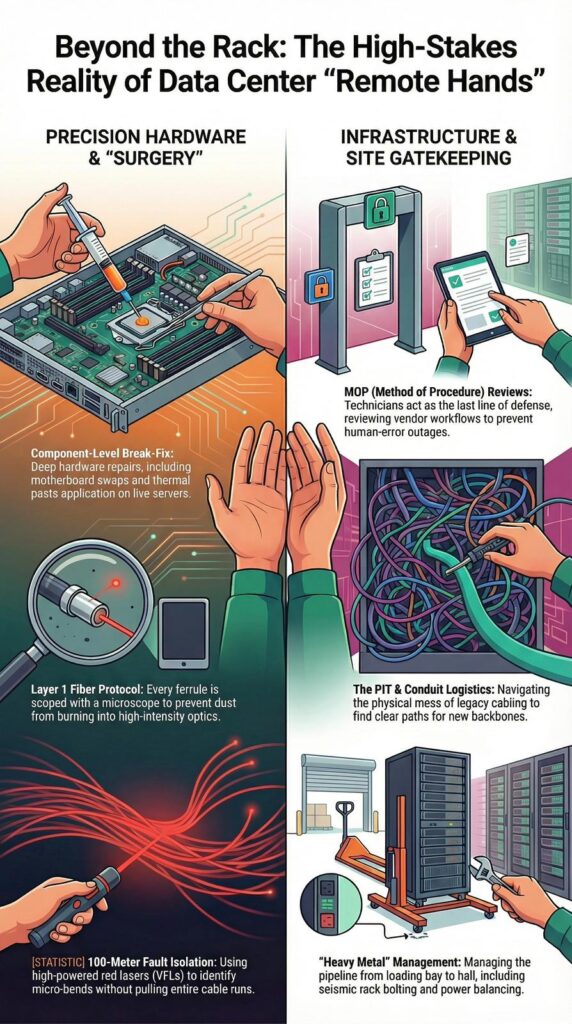
1. Component-Level Replacements
Remote Hands aren’t just swapping servers; they are opening them. This includes:
- CPU and RAM Upgrades: Pulling a blade from a chassis, reseating DIMMs, or applying thermal paste and mounting new heat sinks on dual-processor boards.
- Motherboard Swaps: Moving every component like CPUs, RAM, mezzanine cards, and risers from a failed board to a new chassis.
- NVMe & RAID Controller Replacement: Swapping failed storage controllers or dead NVMe drives while ensuring the RAID array rebuilds correctly.
2. The Nervous System: Cable Laying and Cross-Connects
While logic happens in the chips, the data center lives on its physical paths. A major part of the day is spent in the overhead cable trays and underfloor plenums.
Cable Dressing and Management: They don’t just “plug and walk.” They dress cables using Velcro, ensuring they are labeled at both ends and routed through vertical managers.
Laying the Backbone: This isn’t just “running a wire.” Remote Hands is responsible for laying hundreds of meters of fiber or copper from the MMR (Meet-Me-Room) to the customer’s private cage. This involves navigating complex tray systems while maintaining proper bend radiuses to prevent signal loss.
Executing Cross-Connects: When a customer needs to talk to a carrier, Remote Hands is the one physically “patching” them together. This requires absolute precision, plugging into Port 47 on Rack A and Port 12 on Rack B. One mistake here means a customer’s entire business stays offline.
3. Layer 1 Troubleshooting (The “One-Click” Reality)
When a link goes down, Remote Hands follow a strict physical isolation protocol. It’s not just about swapping cables; it’s about verifying the light path.
- The VFL (Visual Fault Locator) Check: Before assuming an SFP is dead, they use a VFL, a high-powered red laser, to inject light into the fiber strand. If they see a “glow” through the jacket of the fiber or at the patch panel, find a micro-bend or a break. It’s the fastest way to find a physical fault in a 100-meter run without pulling the whole cable.
- The Scope & Clean: It is not just use a “One-Click” cleaner; they need to scope every ferrule with a fiber microscope.
A single speck of dust on a 100G QSFP28 optic permanently “burn” into the lens because the laser intensity is so high. If you don’t scope it, you aren’t fixing it, you’re killing it.
The Gatekeepers: Escorts and Access
Remote Hands Team is the “bodyguards” of the data hall.
- The PIT (Point of Entry) Nightmare: They escort vendors to the PIT to explain the complex pipeline of internal cabling and conduits. The PIT is where theoretical maps meet the physical mess. When a vendor says they can’t find a path, it’s usually because a legacy cable from 2012 is blocking the conduit. Being Remote Hands means getting on your knees in the PIT to find that one clear square inch of space for a customer’s new backbone.
- MOP (Method of Procedure) Reviews: Before a vendor touches a single cable, they sit them down and review the MOP. They are the last line of defense against a human-error outage.
Logistics and “Heavy Metal”
When a customer buys 20 new racks, they manage the “Loading Bay to Data Hall” pipeline.
- Rack Bolting: Ensuring the cabinet is seismically secured to the sub-floor using Hilti bolts or threaded rods.
- Power Connection & Sensory Check: Once bolted, they need to verify the PDU phases are balanced and ensure the rack sensors (temperature/humidity/door) are reporting back to the BMS (Building Management System).
The 24×7 Monitoring & Documentation
Remote Hands Team don’t just sit in the NOC. They watch massive telemetry screens for “Red” alerts.
- Cable Certification: Using Fluke testers to prove a fiber or Cat6a line hits 10Gbps and providing the PDF certification to the customer called as Power Loss Test Report(PLTR)
- The Data Center Bible: They are constantly updating documentation. If a vendor finds a new path through the pipelines in the PIT, we edit the site maps and procedure logs immediately.
Remote Hands Team is always on their toes 24×7, moving between the loading bay, the PIT, and the server rack to make sure the world’s data keeps moving. It’s loud, it’s cold, and the pressure is constant, but without them, the “Cloud” is just a room full of expensive, silent metal.